
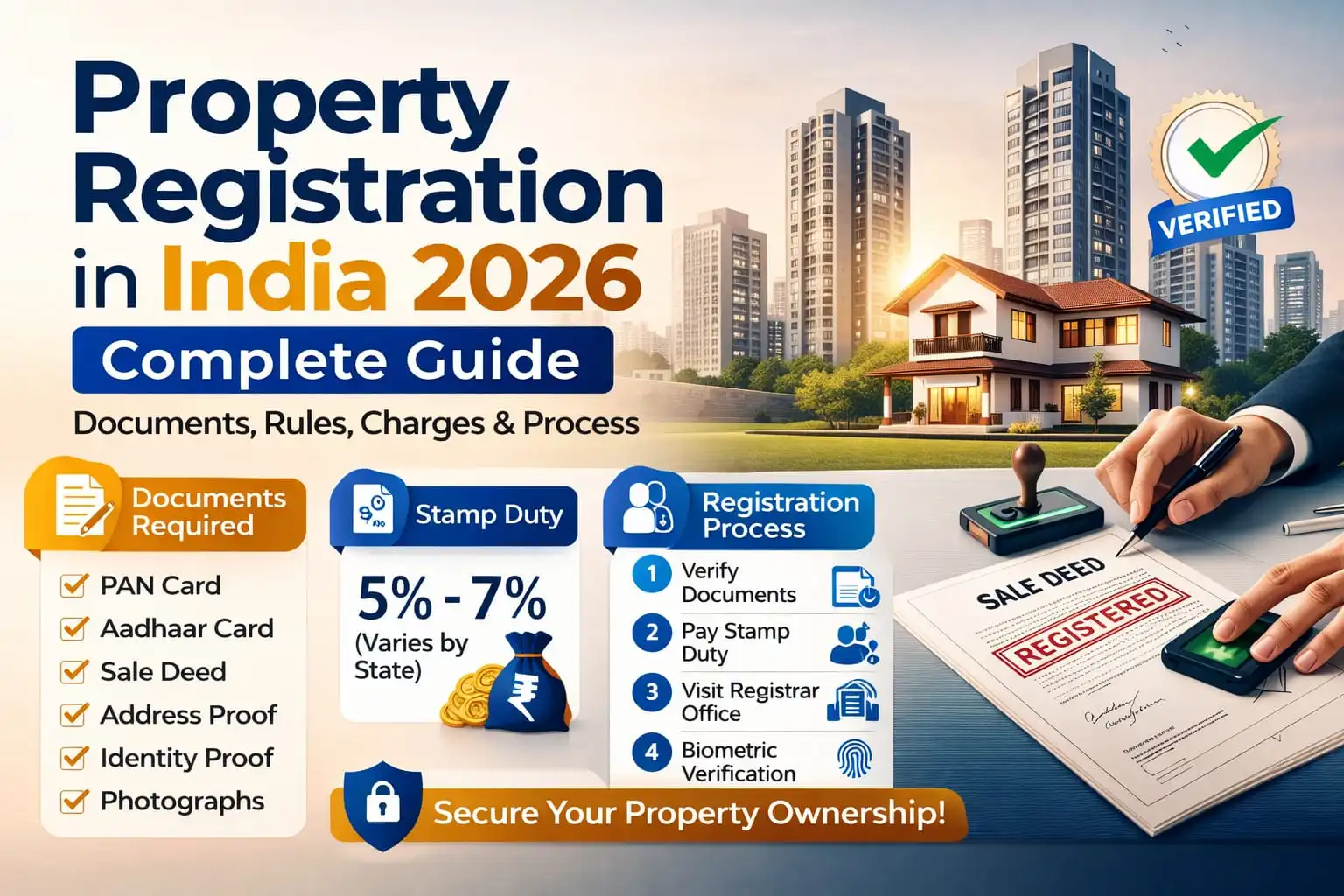
Purchasing property is very fascinating. Registering a property is not so thrilling. Well, here’s the truth: without property registration, you don’t own anything.
In 2026, the process of property registration in India is governed by the Registration Act, 1908. The registration process has been increasingly digitalised, but the guidelines remain very strict.
This guide is for you, especially if you plan to purchase a property within the next year. It will:
Latest Property Registration Rules 2026: Mandatory Documents Required, Registration charges and Stamp Duty Step-by-Step Registration Process Common Mistakes to Avoid. Let’s cut through the red tape.
What Is Property Registration in India?
Property registration simply means officially recording your property purchase with the government. It is the final and most important step after buying a property.
When you register a property:
- The ownership legally transfers to your name
- The government officially records the transaction
- You get full legal protection as the new owner
- Any future dispute becomes easier to resolve
According to the Registration Act, 1908, registration is compulsory for any immovable property valued above ₹100.
If a property is not registered, the sale deed does not hold legal validity in court. In simple words, without registration, your ownership claim can become weak in legal situations.
That’s why property registration is not just a formality — it protects your investment and gives you complete legal rights over your property.
For a complete overview of the property registration process, read our detailed guide on Property Document Mandatory Registration in India 2026.
Read These Articles
Property Registration Rules 2026: Are Two Mandatory Documents Really Required?
RERA Rules 2026: What Changes Are Coming & How It Will Affect Home Buyers
Why Property Registration Matters in 2026
However, real estate fraud is not completely eradicated. In certain real estate locations, issues may also include duplicate sales, forged documents, and disputes of ownership. This is why property registration is not just a formality. It is your protection.
When you register a property:
- It makes an official public record of ownership
- It reduces the chances that a single piece of property may be sold twice
- It validates the payment of the proper stamp duty
- It gives legal validity and enforceability to your documents
Nowadays, with the advancements in technology, many states have made the process easy by providing online appointment bookings and document uploads. In most states, biometric verification of the documents at the Sub-Registrar Office (SRO) has to be performed to complete the registration process.
Simply put, registration helps to safeguard your investment. It might take a bit of time and paperwork, but your ownership is legally secured and protected in the long run.
Property Registration Rules 2026: Latest Updates
Though the major legislation on property registration has not changed, most states are continually improving the process through digitalisation.
In 2026, you’ll see that some similar features are common across various states.
- online slot bookings for registration appointments onlineE-stamp paper systems instead of physical stamp papers
- Aadhaar-based Identity Verification
- PAN being mandatory for high-value transactions
- Verification of circle rates through official online portals
These changes are intended to smooth the process and ensure transparency for the buyer and seller.
That being said, it is always a good practice to check your respective state’s government site for the official registration department before proceeding with the process.
- For example:
- Maharashtra: igr
- Uttar Pradesh: igrsup
- Karnataka: kaver
Though it differs a little, the registration policy remains similar state by state across India.
Mandatory Documents for Property Registration in 2026
Want to register your property in 2026? This is a list of essential documents you may need. It prevents a lot of confusion and chaos at the sub-registrar’s office.
1) Sale Deed (the core document)
This is essentially the basis upon which your property deal is built, and it should include:
- Full names and details of the buyer and the seller
- Completed property description (area, location, boundaries)
- Agreed sale value
- Payment terms and transaction specifics
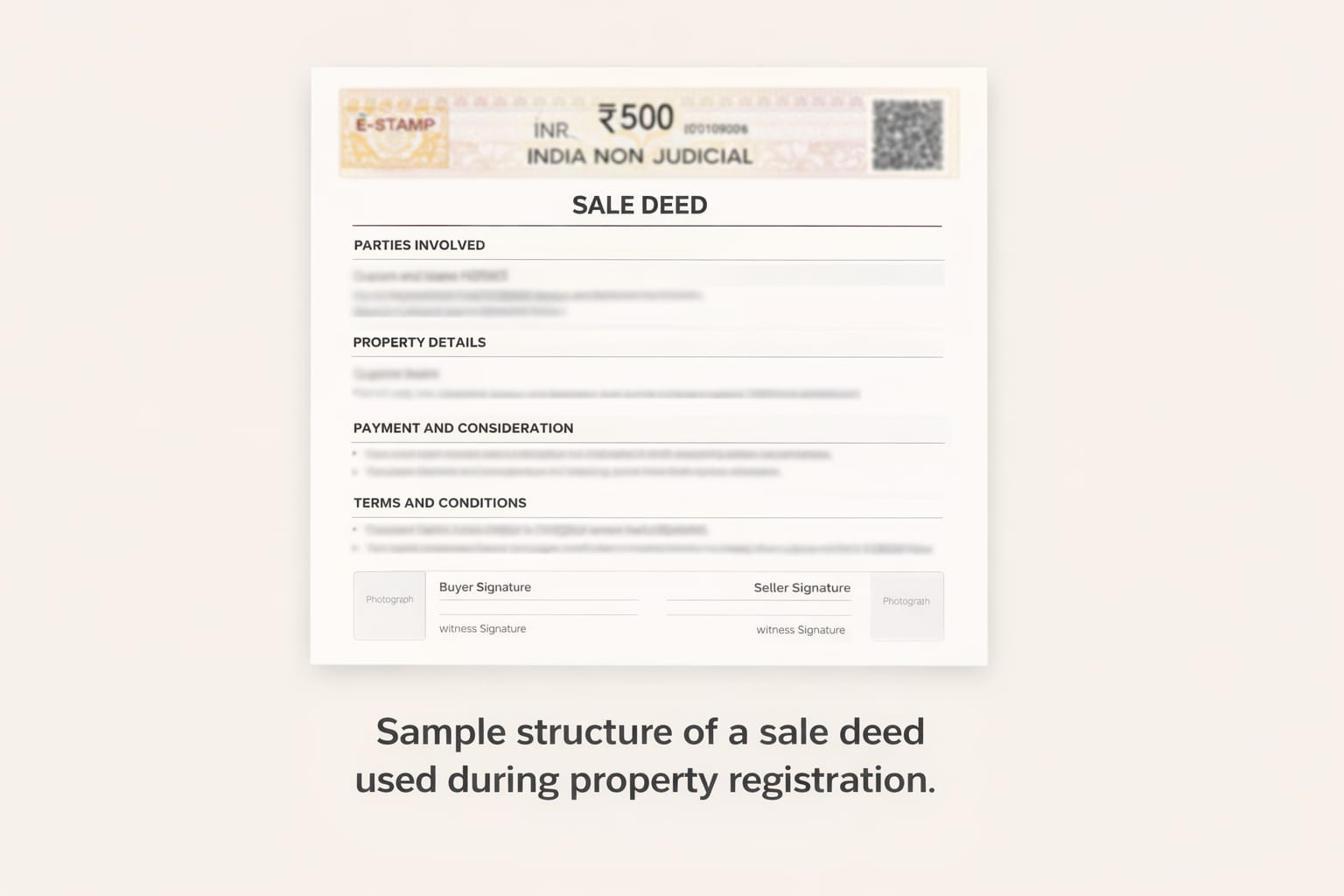
In the absence of a verified sale deed, the registration of the sale cannot be carried out. In other words, no sale deed, no registration.
2) Identity Proof for Buyer and Seller
Both parties have to present valid identification. Generally accepted options:
- Aadhaar Card
- PAN card
- Passport
- Driving License
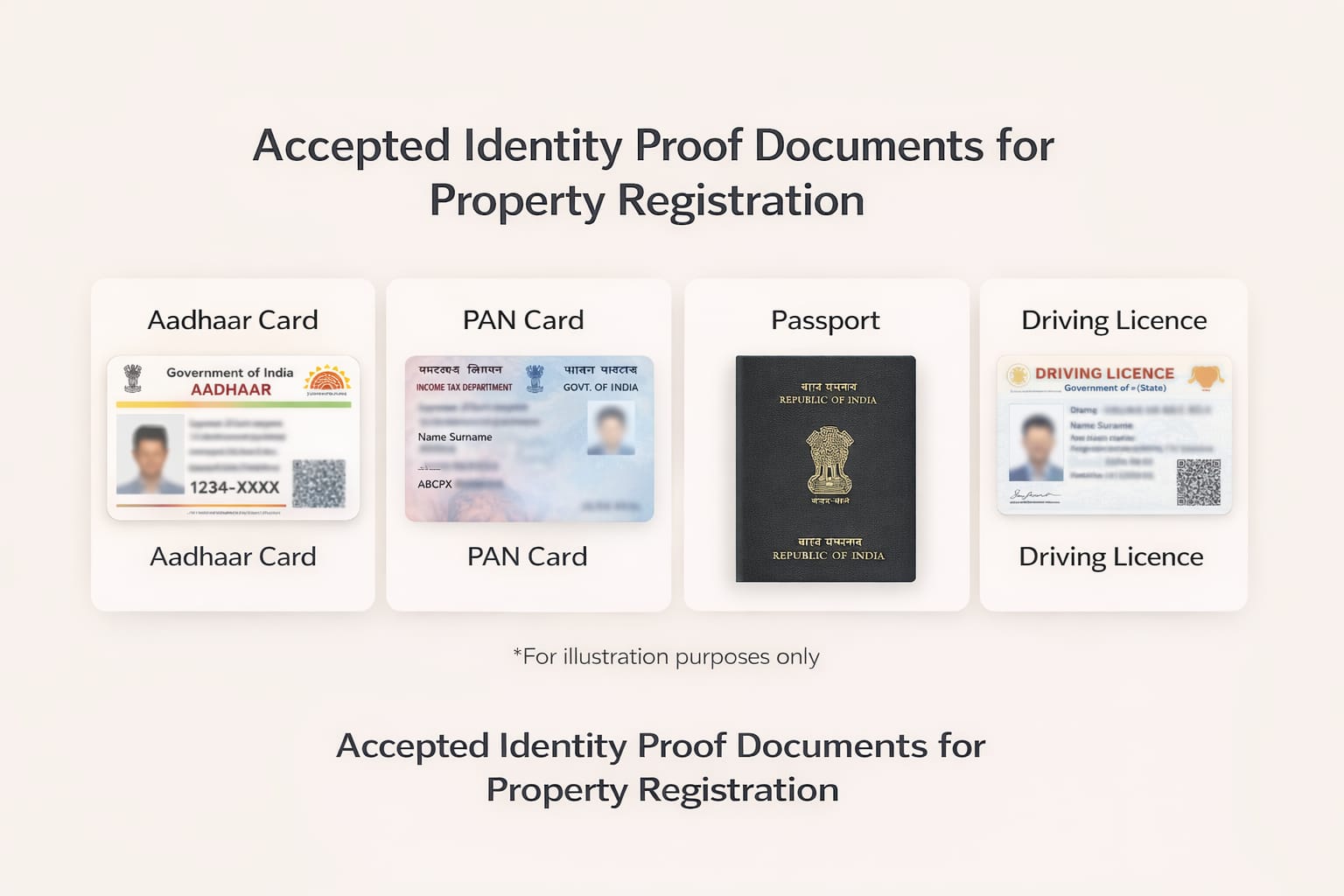
Note: PAN is mandatory in such cases when the transaction value exceeds ₹10 lakh, as per the Income Tax rules. This is for transparency.
3) Address Proof
Also, each party requires proof of address. For that, Aadhaar is usually sufficient, or bills are also acceptable.
4) Passport Size Photos
Recent photos for the buyer and seller are attached to the corresponding registration record for official ID purposes.
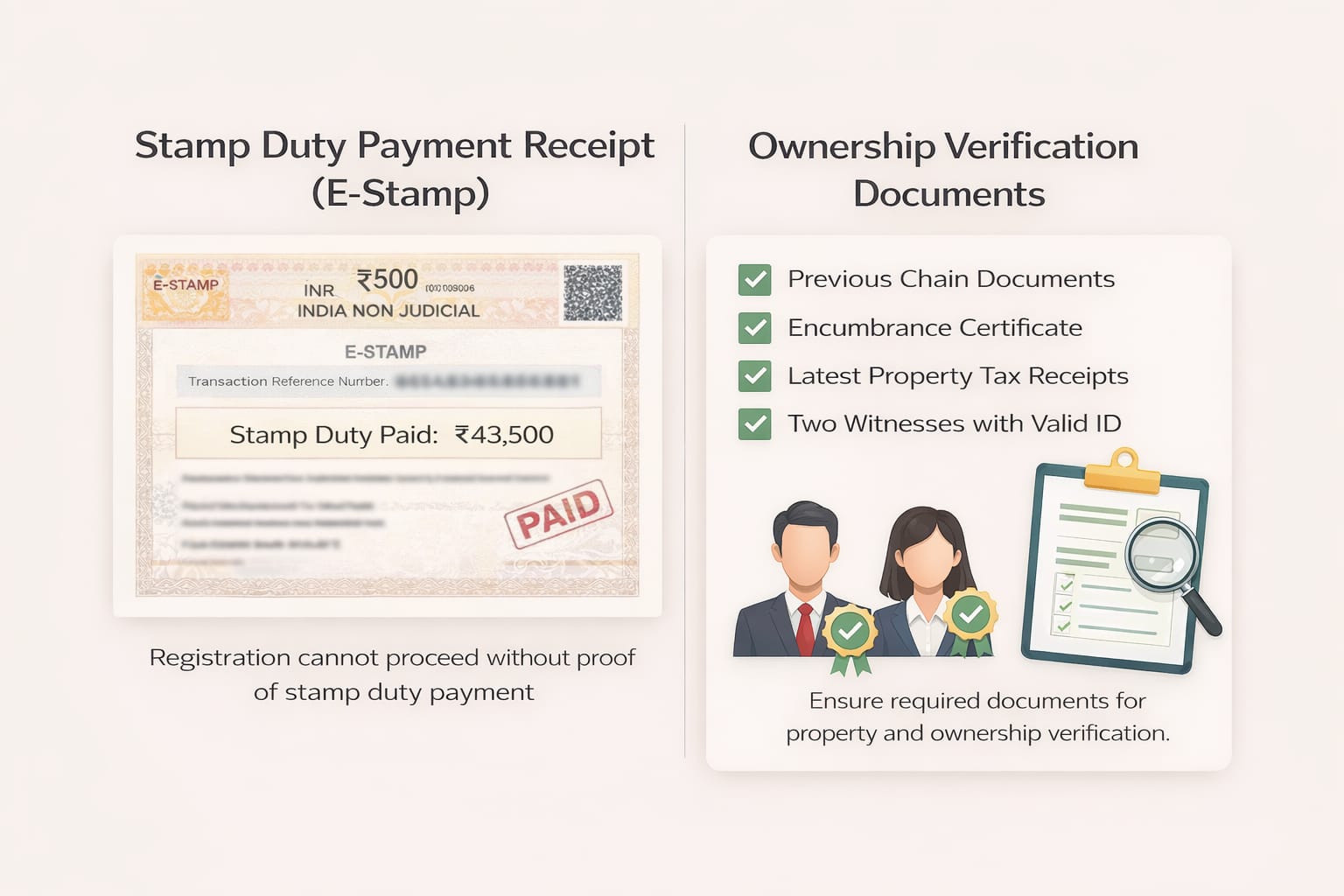
5) Stamp Duty Receipt
Stamp duty has to be paid before the registration begins. States are opting for electronic stamp duty instead of the previous practice of stamp papers. Once the stamp duty is paid, a receipt confirming the stamp duty payment will be sent. Without this, the registration does not happen.
6) Property-Related
These define property and ownership:
- Previous chain of documents
- Encumbrance certificate
Latest Property Tax Receipts. They assist in ensuring that there are no outstanding dues or issues of ownership. 7) Two Witnesses with Valid ID Two witnesses are required who must: – Be present at the registration – Bring valid identification. Their task is to check whether the transaction was voluntary and lawful. Final Practical Tip: Before you schedule the appointment, verify all documents are submitted properly and do not lack any documents or any information on the documents. Yes, the property registration may seem like another tedious paperwork-heavy endeavour, but with the help of the checklist, it is quicker and easier!
Property Registration Charges 2026
When you purchase a property, you are not only required to pay the price of the property, but you are also required to pay some government charges to complete the purchase of the property legally.
There are two main costs involved:
- Stamp Duty
- Registration Fee
Let’s understand both in simple terms.
Stamp Duty in 2026
Stamp duty is a tax levied by the government on the transfer of ownership of property from the seller to the buyer.
Stamp duty rates differ from one state to another. Stamp duty varies from 5% to 7% of the property value in most Indian states.
Good News
- Many states offer concessions like:
- Lower stamp duty rates for women buyers
- Reduced Rates for Affordable Housing
- Discounts for first-time homebuyers
- These benefits can help you save a substantial amount.
- On What Value Is Stamp Duty Calculated?
- Stamp duty is payable on the greater of:
- The sale agreement value
- The government circle rate value
- The circle rate
- Thus, even if you can buy the property at a lower price, the stamp duty will be calculated on the basis of the higher of these two figures.
Always check the official stamp duty website of your state for the latest rates. Registration Fee. After paying the stamp duty, the next step is to pay a registration fee. The registration fee is required for the recording of the property transaction. In most cases, the registration fee is: Around 1% of the property value, or A fixed capped amount (varies by state). For example, the registration fee is usually fixed between ₹30,000 and ₹50,000.
This implies that if the value of the property is very high, you may only be required to pay up to the capped limit.
Final Practical Tip
As property charges vary from state to state, it is always important not to assume anything.
✔ Always verify the latest rates from your state government website
✔ Or check your local Sub-Registrar Office portal
A quick verification can save you from unexpected costs.
Step-by-Step Property Registration Process in India
Buying a property is exciting. But the registration process? Not always. The good news is — once you understand the steps, it’s actually very manageable.
This is how the system of property registration works in 2026:
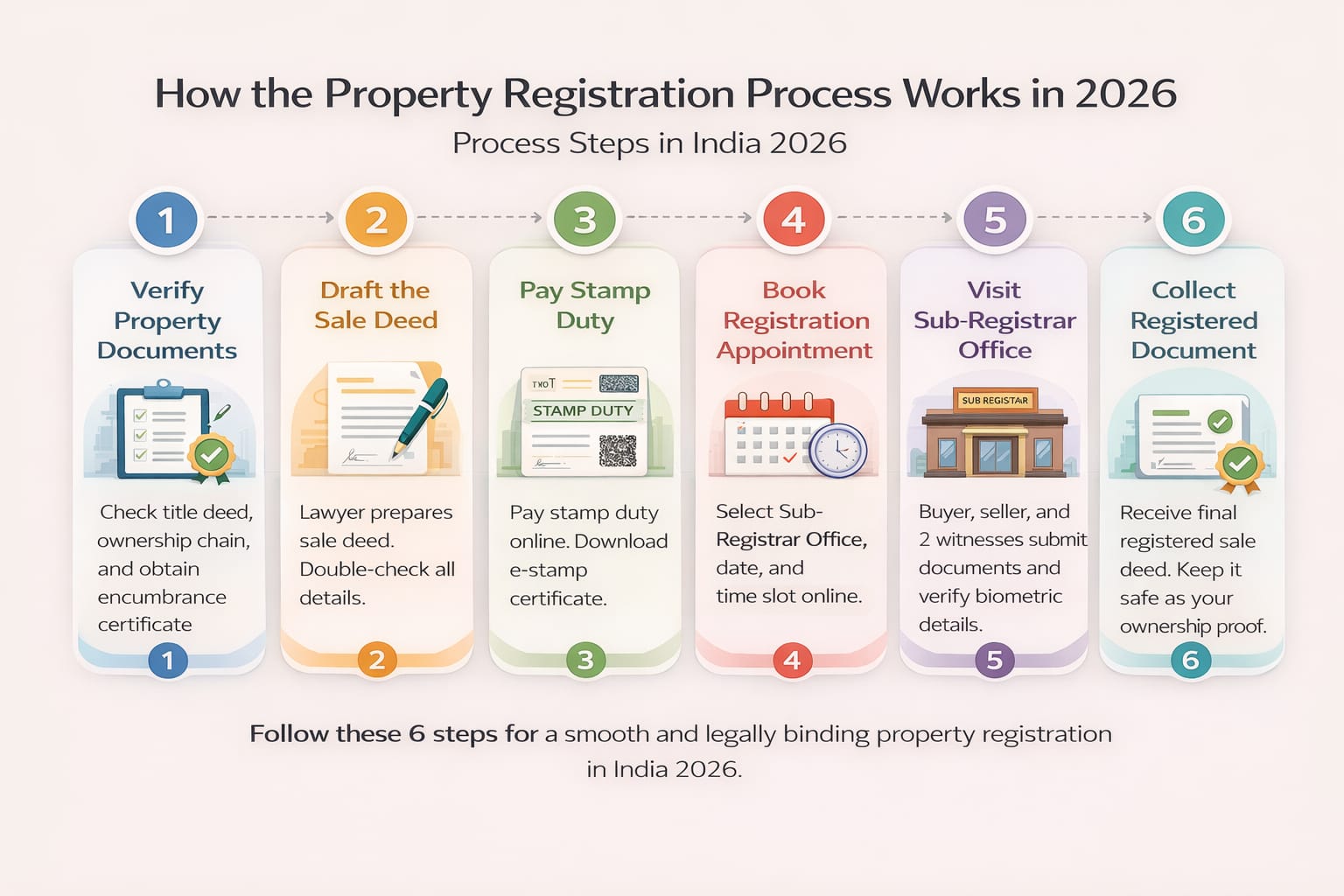
Step 1: Verify Property Documents
- Before you pay anything, do your homework.
- Ensure that you:
- Check the title deed
- Verification of the chain of ownership
- Verify whether any legal disputes are pending
- Obtain the Encumbrance Certificate
- This step will protect you from future legal trouble.
If you are not sure, it is always best to consult a property lawyer for verification. A small legal cost now may prevent a big headache from occurring in the future.
Step 2: Drafting the Sale Deed
After everything is clear, the sale deed is prepared. Usually, it is written by a lawyer or a deedwriter. Double-check the information: Names have to be spelt correctly. Description of property must match official records. Amount of Sale (Consideration Value) should be accurate
Even small errors in spelling can cause a delay in registration. So, read it carefully.
Step 3: Pay Stamp Duty
- Now comes the official payment part.
- Stamp duty is also done online via the state’s online registration portal.
- After payment:
- Download the E-stamp certificate
- Keep the receipt safely
- In the absence of the payment of stamp duty, the registration cannot proceed.
Step 4: Book Your Registration Appointment
- Next, you should book your appointment online.
- Go to the state’s registration website and choose:
- Sub-Registrar Office
- Date
- Time Slot
- Online booking is a blessing in 2026.
- It saves you from long queues of hours of waiting in line.
Step 5: Visit the Sub-Registrar Office
On the appointment day, the buyer must be present. Seller must be present. Two witnesses should be present. You will: Original Documents to be Submitted, Complete biometric verification, Sign electronically or physically. The registrar will review everything before he/she approves the registration.
This is the final official verification step.
Step 6: Collect the Registered Document
Once approved, you are provided with a digitally registered copy. A physical copy will be issued later
This document should be kept very securely. This is your legal proof of ownership.
Final Thought
Yes, there is paperwork involved. However, if you follow each of these steps carefully, it’s smooth and straightforward. The more prepared you are, the smoother And once it’s done?
You are now the official owner of your property
Common Mistakes Buyers Should Avoid
When buying property, the excitement of the purchase may sometimes result in impulsive decisions.
And to be honest, many buyers make small mistakes which may turn into big financial problems.
Here are some common errors you should avoid: Paying a token amount without proper verification, Ignoring the circle rate comparison, Skipping the encumbrance certificate, Under-reporting the property value to save tax, and Not checking builder approval.s These may seem like minor shortcuts.
But even one error may cost you lakhs. For instance, paying a token amount before verifying documents of ownership exposes you to risk in case there are legal problems.
Similarly, under-reporting of property value may seem an easy means of saving money, but it may lead to tax and legal hassles.
Online Property Registration: Is It Fully Digital?
Many people think property registration is now completely online. The truth? Not fully — at least not yet.
In 2026, many states allow partial online processing. You can usually:
- Fill forms online
- Upload documents
- Pay stamp duty online
- Book your appointment
- That definitely makes things faster and more convenient.
- But here’s the important part
- In most states:
- Physical presence is still mandatory
- Biometric verification is required
- Witnesses must be present
- So even though the process starts online, the final step still happens at the Sub-Registrar Office.
- India is slowly moving toward full digital registration, but for now, it’s mostly a hybrid system — part online, part physical.
Legal Basis of Property Registration
In India, property registration does not happen randomly. It occurs under proper laws.
Here are the main laws that control the process:
- The Registration Act, 1908
- The Indian Stamp Act, 1899
- State-specific Stamp Laws
- Income Tax provisions (especially those relating to PAN requirements for high-value transactions)
These laws define how stamp duty is calculated, how a document is registered, and what information is necessary during a transaction.
That is why the proper legal procedure must be followed, as this will protect the buyer as well as the seller.
-
Is Aadhaar mandatory for property registration?
Most states require Aadhaar for identity verification, but specific requirements vary.
-
What happens if the property is not registered?
An unregistered sale deed cannot be used as evidence in court for ownership transfer.
-
Can registration be done anywhere?
No. Registration must occur in the jurisdiction where the property is located.
-
How long does property registration take?
Usually completed within the same day if the documents are correct.
Delays occur due to document errors.
Final Thoughts: Register Smart, Own Secure
There is a reason for the structured, regulated, and legal regime of property registration in India in 2026.
- Yes, it is a bit formal.
- Yes, it does involve paperwork.
- And yes, it can sometimes test your patience.
- Just remember, this is a system that is meant to protect your most valuable asset.
- So always:
- Verify all the documents carefully
- Pay the appropriate stamp duty
- Follow your state’s official guidelines
- Keep both digital and physical copies safely stored
If the registration is done correctly, it will give you ownership and safeguard you from future disputes.
Owning a property helps you create wealth.
Registration helps build long-term security and peace of mind.

Harsh Katyan is a real estate content writer and researcher at Insta India Property. He specialises in covering Gurgaon and the Indian real estate market trends, property investment opportunities, and housing news.
He regularly publishes detailed property guides, market analyses, and investment insights to help buyers and investors make informed decisions.



Join The Discussion