

Purchasing a property is always a thrilling experience. You begin to envision your future dwelling, your favorite spot for a morning cup of coffee, and precisely where your sofa will go. However, here’s the thing most people who purchase a property fail to understand: The actual difference between purchasing land and a flat does not lie in the living room. It lies in the registration papers.
People are mostly concerned with the price tag, the location, and the facilities. However, astute buyers are concerned with what lies beneath the surface—the ownership structure. This one aspect determines how much control you have, how safe your investment is, and how much value it can create in the long run.
In India, owning a property is not only a matter of the heart but also of the law. The laws are governed by the Registration Act, 1908, the Transfer of Property Act, 1882, and the Real Estate (Regulation and Development) Act, 2016. These laws, governed by the Ministry of Housing and Urban Affairs of the Government of India, have strictly outlined the manner in which land and flats can be owned and registered.
So, before you fall in love with the balcony view or the corner plot, it’s important to understand what you’re legally entitled to. Let’s break this down in simple terms.
What Is Property Registration?
Property registration helps in creating a legal document of ownership. When you register property, the government records your ownership in the land records.
According to the Registration Act of 1908, every property buyer must register the sale deed at the Sub-Registrar’s Office. This helps in safeguarding the buyer from fraudsters.
If you do not register property, you will not be the owner of the property. You will only have a private contract, which may not be valid in court.
Registration is necessary for both:
1-Land
2- Flats (apartments)
However, the ownership pattern varies greatly.
What Happens When You Register Land?
When you register your land, you get full and absolute ownership of the land.
This ownership entails:
- Control over the land
- Right to construct, alter, or sell
- Right to everything above and below the land
- No joint ownership with anyone else
The details in your sale deed are as follows:
- Plot number
- Boundaries
- Total area
- Your name as the owner
This ownership is permanent unless you decide to sell it.
Example
When you purchase a 100-square-yard plot in Gurgaon, you get full ownership of the 100 square yards. No one else owns it with you.
You have control over construction, redevelopment, and sale. This provides you with maximum freedom.
What Happens When You Register a Flat?
Flat registration works differently. When you buy a flat, you do not own the land fully. Instead, you own: Your apartment unit A small share of the land (called Undivided Share or UDS)
This difference changes everything.
- Your registration includes two parts:
- Ownership of the apartment structure
- Undivided share in the land
- You do not own a specific portion of land. You share land ownership with all apartment owners.
For example:
If a building stands on 10,000 sq ft of land and contains 10 flats, each owner may get 1,000 sq ft of undivided share.
But you cannot physically identify your exact portion.
The One Legal Difference Every Buyer Must Know
Here is the most important legal difference:
Land registration gives absolute ownership. Flat registration gives shared ownership through an undivided share (UDS).
This single difference affects:
- Control
- Legal authority
- Redevelopment rights
- Long-term value
- Let’s understand this deeply.
Absolute Ownership vs Undivided Share (UDS)
Absolute Title – Land Ownership
When you buy land, you have:
- total ownership rights
- Total control of the land
- Total future rights.
Thus, you can construct whatever is allowed by law. Redevelop any time you desire. Sell independently,
Lease without restrictions; make your own decisions without interference from society or builders.
Putting all of this together creates the maximum level of ownership.
Flat Ownership—Shared Land Ownership
When you buy a flat, you have:
Ownership of the flat
Partial ownership of the land (UDS).
As a result, you must share ownership of the land with the other owners of flats. Thus, there will be limitations to your ownership.
You cannot:
Demolish the building on your own.
Redevelop the property on your own.
Make decisions regarding structures independently.
All owners must make these decisions together.
The “flat ownership” structure exists under the laws applicable to apartment ownership, including the regulations established by RERA and monitored by various authorities (e.g., Haryana Real Estate Regulatory Authority).
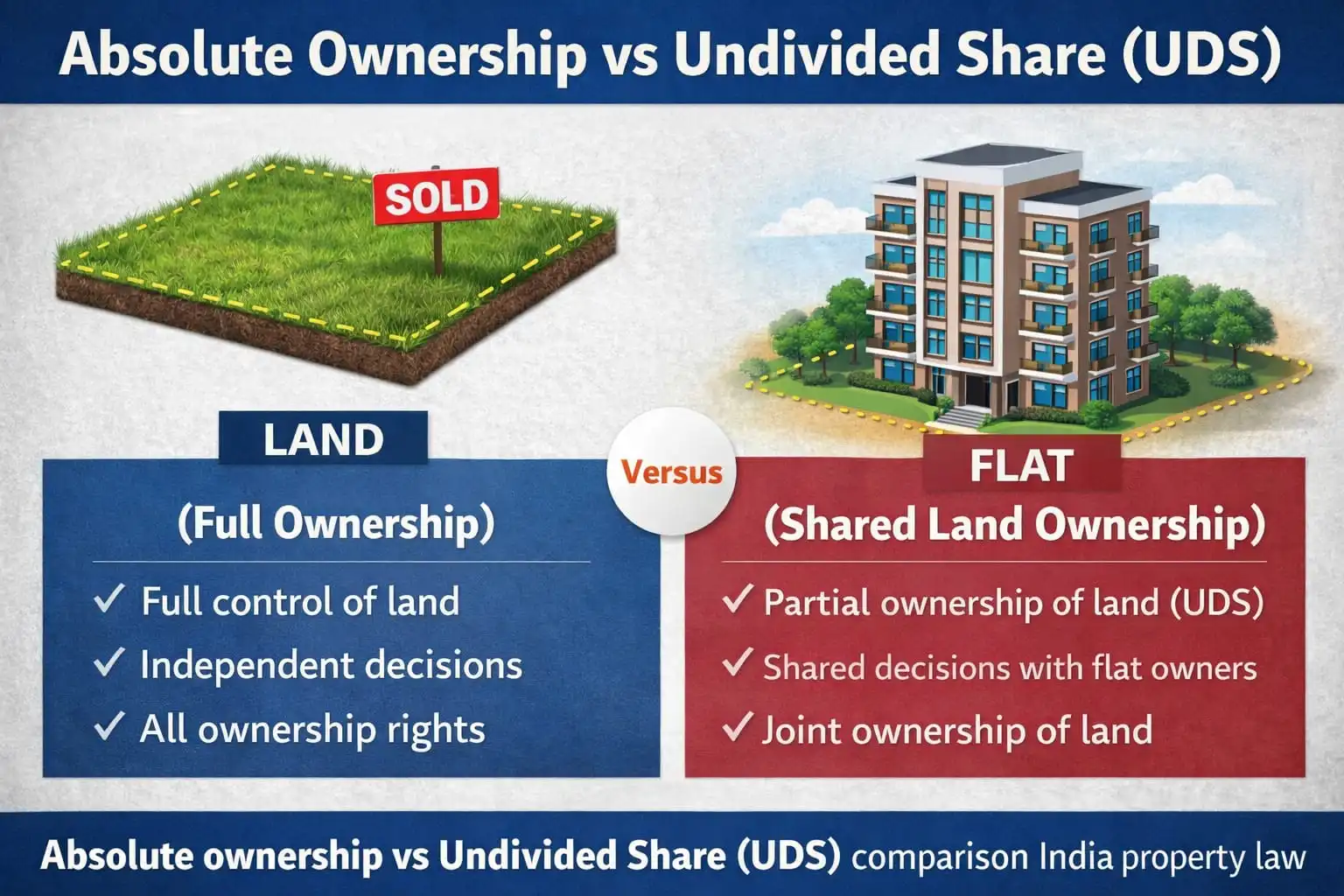
Why This Legal Difference Matters
Variations in owning flats vs. land affect your long-term.
- Property Control
Complete control on land. Landowners make all decisions for their properties.
Limited control over partial ownership (flats) makes it difficult for condo owners to make bigger decisions, such as redeveloping their buildings. - Property Value Growth Rate
Land increases in value faster than flats do. This is because the total supply of land remains constant. Over time, all constructions lose value due to maintenance. Studies agree that the greatest driver of land appreciation versus flats is based on land value. - Redevelopment Authority
If you own land, you can unilaterally decide if you want to build a new building or remodel an existing building on that piece of land; you do not need to get approval from others. If you own a flat, however, all of the other flat owners need to unanimously agree to redevelop (one flat owner can hold up a project for many years). - Structure Life Span
Buildings/structures wear down due to the elements; normally, a concrete structure’s life span can range from 50 to 80 years, depending upon the level of repair & maintenance provided. Land, however, does not wear down and has no expiration; therefore, land will normally be a stronger asset for the long term. - Simplicity of Ownership Rights
When you own land, it is very clear as to what rights you have. Alternatively, owning a flat requires many more levels of complexity: Master Sales Agreement with Developer; Society rules w/ respect to ownership of common elements; Agreements with the other flat owners that specify their rights with respect to common elements (e.g., make sure they pay their share for utilities, etc.). All of this complexity increases the risk associated with flat ownership while at the same time reducing risk simultaneously for individuals who own land.
Legal Basis: What Indian Property Law Says
Indian property ownership follows clear legal frameworks.
- Registration Act, 1908
- This act makes property registration mandatory.
- It ensures ownership transparency and fraud prevention.
- Transfer of Property Act, 1882
- This act governs ownership transfer.
- It defines the legal rights of buyers and sellers.
- Real Estate (Regulation and Development) Act, 2016 (RERA)
- RERA protects flat buyers. It ensures: Builder accountability
- Legal project registration
- Buyer protection
- Authorities under the Government of India enforce these rules.
Key Documents: Land vs Flat Registration
| Factor | Land Registration (Plot) | Flat Registration |
| Ownership Type | Absolute ownership (Zameen aur dhancha dono aapka) | Shared land ownership (Sirf flat aapka, zameen par haq batwara hota hai) |
| Land Control | Full control | Shared control (Society ke sath milkar) |
| Sale Deed | Land sale deed | Flat sale deed + UDS (Undivided Share) |
| Builder Involvement | No | Yes |
| Society Involvement | No | Yes |
| Redevelopment Rights | Independent (Jab chahein tod kar naya banayein) | Group approval ki zaroorat hoti hai |
| Ownership Clarity | Simple aur seedha | More complex (UDS calculation ki wajah se) |
| Long-term Value | Strong (Zameen ki keemat tezi se badhti hai) | Moderate (Building purani hone par value kam ho sakti hai) |
Stamp Duty and Registration Differences
Stamp duty fees must be paid when buying any type of property in India, as they are required fees by law to certify that you are an owner of that piece of property. The rate at which stamp duty will be charged depends on the state in which your property is located and ranges from five per cent to seven per cent of the total cost of your property.
Stamp duty on land purchases is calculated as though you have purchased all the land, because you own the entire area/plot of land. When purchasing a flat, however, your stamp duty will include not only the purchase price of the flat itself but also the amount of “undivided share” (hereafter “UDS”) you have in any land that is associated with your flat. Even if you don’t have a physical piece of that land that you can call your own, your legal right to that land is a part of the value of the property being purchased and will affect the amount of stamp duty paid.
Different states have different laws when it comes to the rate that you may be charged for stamp duty, and so it is important to always verify the current rate for a specific state (e.g., Haryana, Delhi, Maharashtra, Karnataka, etc.) before making a property purchase; therefore, the amount that you will be charged for stamp duty will also affect the total cost of the property you are buying.
Real-Life Example to Understand This Better
Now imagine two different buyers.
Rahul decides to buy a piece of land. Amit chooses to buy a flat in an apartment building.
Fast forward 40 years.
Rahul still owns his land completely. The structure on it may be old, but that doesn’t matter much. If he wants to demolish it and build a brand-new house, he can do it anytime (as long as it follows local building rules). The decision is entirely his. No permissions from neighbours. No group meetings. No delays.
Amit’s situation is different.
He owns an apartment in a building that has now become old. The structure needs redevelopment. But he cannot take that decision alone. The land belongs to all flat owners collectively through the undivided share (UDS). To rebuild, every owner—or at least a required majority—must agree.
Some owners are not ready. Some demand better compensation. Some simply refuse.
The redevelopment plan has been delayed for years.
Rahul moves ahead smoothly with full control. Amit remains stuck in discussions and paperwork.
This simple example clearly shows how ownership structure can shape your future rights, flexibility, and decision-making power.
Risks Buyers Ignore (And Later Regret)
Many buyers don’t pay much attention to the Undivided Share (UDS) when purchasing a flat. At the time of buying, the focus is usually on the flat size, location, price, and amenities. UDS often feels like a technical detail that doesn’t matter much — but this small detail can create serious problems in the future.
If your UDS is low or unclear, your redevelopment rights become limited. When the building gets old and needs rebuilding, your ownership strength depends on your land share. A smaller UDS means a weaker influence in redevelopment decisions.
UDS issues can also lead to legal disputes with builders, especially if the land share was not properly defined or documented. In some cases, it even creates conflicts within the housing society, as multiple owners may disagree on redevelopment, repairs, or ownership matters.
Another hidden impact is on resale flexibility. Today’s buyers are becoming more aware and cautious. If your flat has a lower or unclear UDS, future buyers may hesitate, which can affect your property’s resale value and demand.
That’s why smart buyers don’t just look at the flat — they carefully verify the ownership structure, including the UDS, before making a decision. This ensures stronger legal rights, better long-term security, and fewer complications in the future.
How to Check Ownership Before Buying
Always verify these documents.
For land:
- Sale deed
- Title deed
- Land records
- Encumbrance certificate
For flats:
- Sale deed
- Undivided share details
- Builder approvals
- RERA registration
- Occupancy certificate
Authorities under the Ministry of Housing and Urban Affairs recommend verifying legal approvals before purchase.
Which Is Better: Land or Flat?
Your decision of whether to purchase land or a flat ultimately relies on your specific goals and priorities.
When it comes to long-term investments, land is typically the best option. You will have total ownership of the property which allows for the freedom of construction or redevelopment as per your desire. As a result of limited land supply and increasing demand, land also has a far greater appreciation potential compared to current property.
Conversely, if your goal is to obtain immediate living arrangements that are convenient, a flat will be the better choice. Flats are generally ready to move into, require less of an initial investment than purchasing prime land, and provide you with the benefits of living in an urban lifestyle (security, maintenance services and easy access to the city’s infrastructure).
Both land and flats have their own benefits. Land provides an owner with a strong ownership position and the opportunity for long-term appreciation, whereas flats provide an owner with access to comfortable urban living. By understanding the ownership structure, you can make an informed decision for your future and protect your investment.
Expert Tip: Most Buyers Ignore
Whenever you’re buying a flat, don’t ignore the Undivided Share (UDS) mentioned in the documents. It may look like a small technical detail, but it plays a big role in how strong your ownership really is.
A higher UDS means you own a larger share of the land beneath the building. That gives you stronger legal standing and better long-term security. On the other hand, a lower UDS means your land rights are smaller, which can reduce your influence in major decisions like redevelopment.
In many high-rise projects, builders divide the same piece of land among a large number of flats. As the number of units increases, the individual UDS for each buyer often becomes smaller. This may not seem important at first, but over time, it can affect your ownership strength and even future property value.
That’s why it’s important to carefully review the UDS mentioned in the sale deed before you sign anything. A few extra minutes of verification today can protect your rights for decades.
Conclusion: The One Difference That Changes Everything
At first glance, buying land and buying a flat may feel similar. In both cases, you pay money, sign documents, and become a property owner. But the truth is, the legal ownership you receive is very different — and this difference can shape your control and financial security for years.
When you register land, you become the complete and absolute owner of that land. No one else shares that ownership with you. You have the freedom to build, redevelop, sell, or hold it for the future without depending on anyone else’s approval.
With a flat, the situation changes. You fully own your apartment, but the land beneath the building is shared with other flat owners through what’s called an Undivided Share (UDS). This means major decisions related to the property — especially redevelopment — require agreement from multiple owners. Your ownership is real, but it comes with shared control.
This single legal difference directly affects your legal authority, investment strength, and future flexibility. Many buyers don’t pay attention to this detail in the beginning. They focus on interiors, amenities, and price. But years later, when redevelopment or ownership issues arise, they realise how important the ownership structure really is.
Smart buyers take the time to understand what they are legally owning before making a decision. Because property is not a short-term purchase — it’s something that can impact your finances and freedom for decades.
In real estate, attractive interiors may catch your eye, but true power lies in the ownership you hold. Choosing wisely today can give you stronger control and peace of mind in the future.
Disclaimer: This article, “Land vs Flat Registration: One Legal Difference Every Buyer Should Know,” is for informational and educational purposes only. Property registration laws, ownership rules, and stamp duty regulations may vary by state and individual cases. Readers should consult a qualified legal expert, property consultant, or local registration authority before making any real estate decision. Always verify official documents and follow current government guidelines.
Related Articles-
Property Registration in India 2026: Complete Guide (Documents, Rules, Charges & Process)
Rent Agreement Rules 2026 in Haryana—New Law, Validity & Penalty Explained

Harsh Katyan is a real estate content writer and researcher at Insta India Property. He specialises in covering Gurgaon and the Indian real estate market trends, property investment opportunities, and housing news.
He regularly publishes detailed property guides, market analyses, and investment insights to help buyers and investors make informed decisions.




Join The Discussion