
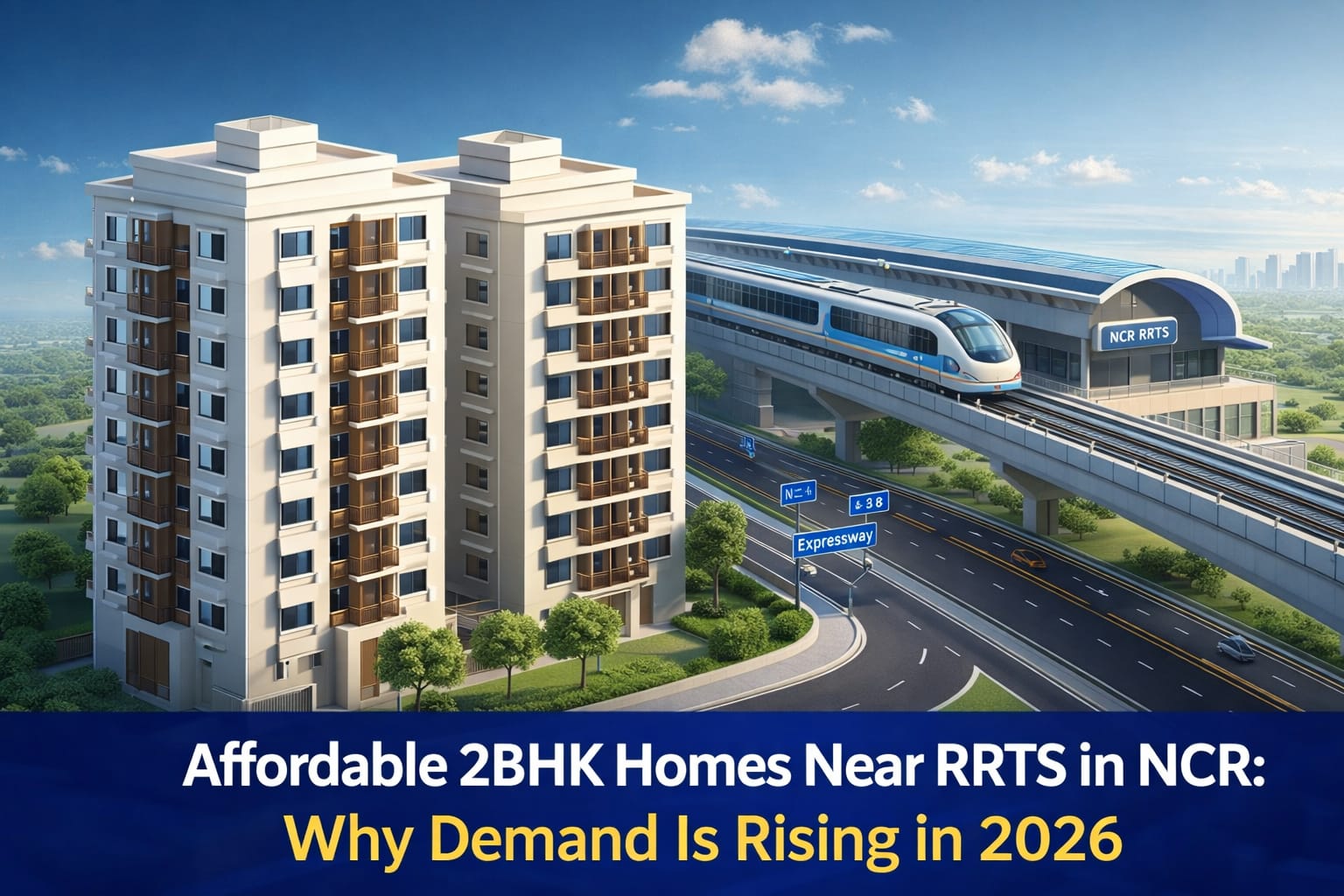
The year 2026 has officially arrived in an entirely different way than in the way it will appear on the skyline of the National Capital Region (NCR) – the skyline has not only added a few more skyscrapers, but it has also gone through a complete structural transformation. A trip on the Delhi Meerut Motorway in 2024, when you found yourself stuck in three hours of heavy traffic and wondered what in the world was happening to your career and where you would go from here, will leave you with feelings of being completely lost when you see the current reality of 2026. The Regional Rapid Transit System (RRTS) is commonly called the Namo Bharat, but now it is not just a collection of glossy picture books and ambitious press releases about an imaginary railway project; it is a 160 km/h train that is turning the “far-away” suburbs of Ghaziabad and Meerut into the new “front yard” of Delhi.
Due to this tectonic shift in connectivity, we have seen a surge in demand for affordable 2BHK homes along these new corridors. The question is simple: why would a young professional pay an exorbitant amount to live in a cramped shoebox apartment located in a congested area of South Delhi when they have an opportunity to own a spacious 2BHK apartment within a gated community in Duhai or Modinagar, yet only a short 45-minute train ride away (with Wi-Fi access at each station) from work? In this report, we provide a thorough analysis of the economic, social, and infrastructure factors driving this new real estate boom, serving as a roadmap for investors and homeowners as they navigate the 2026 marketplace.
The Connectivity Catalyst: RRTS and the End of the “Distance” Era
The 82 Km Delhi-Ghaziabad-Meerut corridor has equated distance on a map with time through the addition of “Namo Bharat” trains, which travel the distance of 82 Km in 50 minutes or less; therefore, the NCR (National Capital Region) and its geography, the town-to-town distance from one to the other in the city, will not matter, because it will always be less than 50 minutes away from one another (using the “Namo Bharat” train service) The entire area of the NCR was completely collapsed into one region, hence the complete refitting of a regional map of India; it now flows from the Delhi Metro Rail Corporation through Meerut, allowing for the regional interaction of business.
The upgrade does not include only the RRTS (Regional Rapid Transit System) but also includes the completion of all Phase IV corridors (due to their proximity to the RRTS) of the Delhi Metro Rail Corporation, all of which are being completed and connecting to the RRTS. They were completed in conjunction with the completion of phase 4 of the Delhi Metro, ultimately creating a second web of connectivity through phase 4. The connectivity of both systems now allows for residents of 2BHK flats (two bedrooms, hall, kitchen) in the Meerut South area to literally use one interchange to get to and from the heart of the capital’s (New Delhi) central business district(s).
| Key RRTS Milestone (2026) | Operational Status | Impact on Housing Demand |
| Full Delhi-Meerut Corridor | Fully Operational (82.15 km) | Peak demand in satellite towns like Modinagar and Duhai. |
| Sarai Kale Khan Mega-Hub | Fully Integrated | Increased premium for properties with direct Delhi access. |
| Interoperability | Phase 1 Corridors Converging | Future-proofing for Alwar and Panipat connections. |
| Meerut Metro Integration | Shared Infrastructure | Massive boost to internal Meerut real estate values. |
The Sarai Kale Khan Multi-Modal Effect
Sarai Kale Khan Station has grown to be at the forefront of this new urban environment. It is not only a transit station but also a masterpiece of logistics. The RRTS has merged with the Pink Line Metro, Hazrat Nizamuddin Railway Station, and Veer Hakikat Rai ISBT to provide commuters with a seamless experience and eliminate “interchange fatigue”. With 12 escalators, 4 lifts, and platform screen doors installed within the station, the transition between modes will be as quick and easy as taking the train. For a buyer of a 2BHK located in one of the suburbs surrounding Delhi, this station is a clear indicator that they will have a connection to the heartbeat of the city.
The Psychology of the 2026 2BHK Homebuyer
What makes the 2BHK an unrivalled leader in the 2026 real estate market is due to changing priorities among millennials and Gen Z. With the advent of hybrid working schedules after the pandemic, there is now an “extra room” requirement called a “home office” when seeking a home to purchase.
According to Knight Frank’s Market Research Report, approximately 66% of users of the RRTS system are interested in buying property in the RRTS Corridor area, with the 2BHK being the top searched property type. When these potential buyers search for homes, they are not necessarily concerned with obtaining affordable housing; they are looking for high-quality, value-added options. Buyers are requesting gated developments, backup power supplies, and easy access to public transportation. While these types of developments were considered “luxuries” in the past, they are now viewed as critical features for leading a productive life.
The End of the “Delhi Or Bust” Mentality
The trend of moving to cities with a high level of prestige has finally given way to the more rational approach of moving to areas where the surrounding environment, transit system and social infrastructure are better than in the central urban area. By 2026, research reports show that 38% of respondents in NCR will consider moving away from core urban centres. Moving away from extremely high-concentration markets has helped to alleviate some of the burden placed on the NCR by decades of over-concentration. The term “Affordable 2BHK” is associated with the new RRTS transit system, which provides a sound roof over the heads of people that are no longer stuck paying outrageous rents and suffering from poor air quality due to living in inner-city locations but also provides them with easy access to the same types of employment opportunities they had when they were living in the core urban centre.
Micro-Market Analysis: The Duhai-Morta Residential Cluster
Duhai has turned from a technical depot to a residential growth area. In early 2026, properties around Duhai depot and Duhai stations were among the fastest-growing in terms of value in Ghaziabad. As a result of this rapid growth, average property prices in Duhai now range between ₹ 5800 and ₹ 9595 per square foot, depending on how close you are to the station and the quality of the developer.
Overview of Landcraft Metrohomes
Landcraft Metrohomes has emerged as a prime example of the rapid rise in the real estate market, in part due to the government-led development of the RRTS corridor, which is located in Duhai. These homes are situated close to the future RRTS station as well as the Eastern Peripheral Motorway and contain both 2BHK and 2BHK + Study unit options. There continues to be a strong demand for this property, not only by end-users but also by investors. Between now and the beginning of the year 2026, the average pricing for these 2BHK units will range from ₹47 Lac to ₹62 Lac, making them a more budget-friendly option than similar-sized units in Noida Sector 150, where many properties are priced at over ₹1.5 Cr.
| Property Type in Duhai/Morta | Configuration | Price Range (2026) | Availability |
| Landcraft Metrohomes | 2BHK + Study | ₹42.5 L – ₹62 L | Resale & New Possession |
| Moti Residency (Morta) | 2BHK | ₹40 L – ₹50 L | Ready to Move |
| Aditya Urban Homes | 2BHK | ₹47 L | Integrated Township |
| Bliss Saraswati Apartment | 2BHK | ₹16.6 L | LIG Focus |
A great reason for investing in Duhai is that it connects directly to the Eastern Peripheral Motorway, which means that residents can completely avoid Delhi when travelling to cities like Palwal or Sonipat. The connectivity offered by the EPE gives Duhai a “bi-directional” appeal to people whose jobs and homes are located in both northern and southern parts of the National Capital Region (NCR).
Modinagar: The New Hub for the Value-Conscious Professional
Duhai is the gateway to the essence of affordable housing in 2026, but Modinagar (also known historically for its Industrial Legacy) is the heart of the affordable housing segment. This township has recently reinvented itself as a hub for young families and first-time buyers to call home. Residents will benefit from two major transportation hubs (Modinagar North & Modinagar South) located at either end of the township, allowing them to be within minutes of high-speed transit options.
Indiscernibly, the average housing price for 2BHK units in Modinagar is about ₹5,770 per sqft, making it one of the most easily accessible markets for purchasing 2BHK units. With this information in mind, the market is also being driven by many reputable developers, including Kannan Group and Techman Buildwell, who are establishing projects that re-energise the modern aesthetic and affordability that Modinagar maintains.
Why the Increasing Demand for Modinagar Housing?
The current demands for purchasing housing in Modinagar are attributed to two primary groups: “local upgraders” and “outbound commuters”. Many of these families lived in congested urban locales previously (before moving to houses in new gated communities such as Kannan Greens and Moti City). Increased security and amenities found in these new gated communities are appealing to local upgraders.
Conversely, Outbound Commuters embraces a new alternative for commuting to their workplace and subsequently pulling off the high stress of travelling long distances to get there. As a result of the development of the RRTS Project, Modinagar will now become an option for those commuting to the Ghaziabad Industrial Belt or even the Delhi Central Business District (CBD). Additionally, the continued growth of established hospital facilities, such as Shakuntala Hospital and City Care Hospital, allows the surrounding area to develop the social infrastructure necessary for these families to establish roots in Modinagar.
Meerut: The 2026 Real Estate “Dark Horse”
A lot can change in 4 years, but few cities can boast of such a dramatic transformation as Meerut will experience in 2026. Once a relatively separate city with a very different culture and economy, Meerut has steadily become part of a larger commuting area to Delhi. According to experts, anticipations around the real estate market in Meerut will be very positive, with price increases expected in the higher-end real estate markets of Modipuram and Pallavpuram, which will see increases in value of approximately 40%.
The Modipuram Terminal Effect
As the terminus of the RRTS corridor and mid-way hub of the depot, Modipuram has become an area for a significant influx of commercial and residential development. Because Modipuram is the point at which the entire Western UP region transitions into the Greater Delhi area, many investors have been drawn to the opportunity that exists for Modipuram to be on the very cusp of this transition. For example, buying a 2BHK apartment in Modipuram is no longer just about being able to have a place to live but, more importantly, it is becoming a key part of building a strategic portfolio in a rapidly modernizing city.
| Meerut Micro-Market | Current Avg Price (sq ft) | 2026 Est. Growth | Key Driver |
| Modipuram | ₹3,800 | 30–40% | RRTS Terminus & Commercial Hub |
| Pallavpuram | ₹5,200 | 25–35% | High-end Gated Societies |
| Shastri Nagar | ₹3,500 | 20–30% | Established Social Infrastructure |
| Ganga Nagar | ₹3,000 | 20–25% | Educational Hub Proximity |
Meerut South has also emerged as a destination for UPAVP in 2026. The Bhagirathi Enclave, Jagriti Vihar, offers affordable government-supported 2BHK units priced from ₹18 Lac to ₹27 Lac. These units are “ready to move” meaning they are perfect for families seeking immediate relief from the ongoing challenge of renting.
Several government housing schemes have helped fuel a rise in demand for 2BHK homes. The Ghaziabad Development Authority (GDA) and the Uttar Pradesh Awas Vikas Parishad (UPAVP), along with an increase in demand for properties near the Delhi-Meerut Regional Rapid Transit System (RRTS) by 2026, are ensuring that “affordable” remains an option for buyers looking at 2026 housing options as part of the RRTS expansion and to help with purchase decisions.
The Harnandipuram Township is part of the 2026 housing expansion project. Located over 521 acres on the banks of the Hindon River, the Harnandipuram Township / Project is designed to create a planned, integrated community to relieve overcrowding in the urban areas of Ghaziabad. Due to its proximity to the RRTS and the Delhi-Meerut Highway, the Harnandipuram Township will provide a large amount of residential land and 2BHK Apartments that will be sold at a competitive price point for the Middle Income Group (MIG) and Low Income Group (LIG) classifications.
20 Percent Mandate Through PMAY
The Pradhan Mantri Awas Yojana (PMAY) is still an important part of the housing industry in 2026; it mandates that developers must build 10% of their units for the EWS and another 10% for the LIG. Projects such as Prateek Aurelia located within Siddharth Vihar are now offering “inspiring homes” that fit within buyers’ budgets while also providing residents with access to the greater township’s amenities. In 2026, PMAY is no longer viewed as simply an initiative for social welfare, but rather as a means to stabilise market conditions and keep the RRTS corridor from being developed into an upscale enclave only for the wealthiest citizens.
The Investor’s Perspective: Rental Yields and ROI in 2026
Rental income from the RRTS corridor will be a booming market for smart investors in 2026. Generally, rental yields for residential properties in India are between 2.5 – 4.5%, whilst properties directly adjoining RRTS stations tend to achieve the higher end of this yield band.
The “Commuter-Tenant” Niche:
In general, a 2BHK property located near an RRTS station has an abundance of potential renters, with the majority being what’s known as “commuter-tenants.” Typically, a commuter-tenant is a professional who works in either Delhi or Noida but appreciates the value of having an affordable rent and access to modern facilities that are commonly found in satellite towns. A 2BHK at a price point of ₹45 Lac to ₹55 Lac in Raj Nagar Extension or Duhai could achieve an average monthly rental income between ₹15,000 and ₹22,000, depending on the level of furnishing. This scenario results in a strong ROI when coupled with an 8-10% CAP gain annually being experienced in this area.
| Investment Metric | 2026 Performance | Reason for Strength |
| Capital Appreciation | 8.3% (NCR Average) | Infrastructure completion and high demand. |
| Rental Yield | 3.5% – 4.5% | Influx of Delhi-based professionals seeking value. |
| Resale Velocity | High for 2BHK Units | “Right-sized” units are the most liquid asset class. |
| Occupancy Rates | 90%+ in Gated Societies | Last-mile connectivity and safety features. |
Transit-Oriented Development (TOD): The Science of 2026 Urbanism
The trend of demand for 2BHK (two-bedroom, hall and kitchen) apartments and availability (i.e., “availability and want”) is not about the physical structure – it’s about how buyers view the availability of these homes, and whether they consider them to be good long-term (located) property investments.
The new TOD (Transit-Oriented Development) regime has changed everything in the NCR, both because it promotes mixed-use and the highest-density, walkable neighbourhoods, and because it diminishes people’s dependence on cars.
Value of Transit-Oriented Development
According to 2026 data analysis, people living in TOD neighbourhoods have reduced their Vehicle Miles Travelled (VMT) by 28% to 41% compared to those residing outside of TOD neighbourhoods. These two main benefits of living in a TOD neighbourhood allow lower-income households to afford to live in TOD neighbourhoods while still having more disposable income available for their monthly expenses than they would have if they lived outside of TOD neighbourhoods. This is creating a “financial cushion” for many of these families, thereby allowing them all to occupy 2BHK residences in a TOD neighbourhood.
Last-Mile Connectivity: The Final Piece of the Puzzle
In 2026, the RRTS project will have a direct connection to the overall ridership of the RRTS trains and their integration to the public transportation system. Without an efficient mode of transportation within the last mile, RRTS trains will not serve their purpose as they were designed. To address this issue, NCRTC has developed and implemented an extensive network of feeder bus services across the region.
DTC + Feeder Bus Service
NCRTC has partnered with the Delhi Transport Corporation (DTC) and other local bus operators to allow commuters to easily connect between the RRTS stations at New Ashok Nagar, Ghaziabad and Meerut South with local buses that are coordinated with the arrival times of RRTS trains. This provides commuters with seamless transfers from the RRTS stations to the neighbourhoods in which they live or work. The most notable of these integrations can be found at the New Ashok Nagar station, which has installed Foot Over Bridges (FOBs) that connect directly to the existing Metro concourses, allowing commuters to stay dry while transferring from RRTS to Metro.
The Future of Connectivity – Alwar and Panipat Suburbs
As the Delhi-Meerut expressway is well underway to become a major roadway by 2026, many savvy property buyers have started to look into the “next big thing.”
Investing Early in Bhiwadi & Sonipat (Preemptive)
Between now and early 2026, buyers in locations like Bhiwadi and Sonipat are experiencing similar actions to those who pursued buying properties earlier this year when they invested in Meerut. Currently, tenders for design consultants and utility relocations for these corridors have been published. An investor purchasing a 2BHK in Bhiwadi now (with current prices in the low ₹30 to ₹40 lakh range) will likely see a significant profit as the “Namo Bharat” initiative arrives and begins its inevitable price rise. The promise of a 117-minute commute to Alwar and a new 24×7 highway will significantly enhance Bhiwadi’s desirability as a prime residential space.
Logic, Humor and Facts about 2026
2024: If you lived in Meerut and worked in Delhi, people would likely think of you as an idiot who just ran a marathon but did not stop after crossing the finish line. People in 2026 will ask for your realtor’s phone number because now they know what the RRTS has done to eliminate the ‘sacrifice’ aspect of suburban living.
Gone are the days when living in satellite towns meant living in a bubble or living life continuously through the rearview mirror of your car. The Namo Bharat train is an innovative piece of technology designed and manufactured in India with top speeds of 160 km/h, and it has changed our entire lifestyle to include an improved method of commuting. The difference between getting home in time for your child to go to bed or being able to attend their college graduation.
Conclusion: Why 2026 is the Year of the Smart Homebuyer
A growing demand for affordable 2BHK units in the environs of the RRTS is simply the organic effect of an area realizing its potential. “In 2026, the National Capital Region is a full-fledged polycentric-region-based economy.” So what better ways to ring in this new decade than in the 2BHK home, where the realities of work, lifestyle, and the train experience all come together in one neat package?
Whether you’re a first-time buyer seeking a stable future or an investor seeking the next hot destination, the takeaway is clear: the corridors in the Namo Bharat are the prized property in North India. The “Distance” era is now just a distant memory. Welcome to the “Connection” era. In the year 2026, “the smartest people in the room hold the key to a 2BHK in the RRTS station neighborhood.”
Final Summary Table: The 2026 RRTS Housing Landscape
| Locality | Station Connectivity | 2BHK Price Range | Demand Level | Best For |
| Duhai/Morta | High (Depot Hub) 15 | ₹42 L – ₹62 L | Extreme | Young Professionals |
| Modinagar | High (Two Stations) 2 | ₹30 L – ₹45 L | High | Nuclear Families |
| Meerut South | Extreme (Metro Integrated) 5 | ₹25 L – ₹40 L | Very High | Investors/Upgraders |
| Raj Nagar Ext. | High (Near Ghaziabad Stn) 12 | ₹50 L – ₹75 L | Moderate | Lifestyle Buyers |
| Siddharth Vihar | High (Near Sahibabad) 27 | ₹45 L – ₹80 L | High | Delhi Commuters |
The takeaway for 2026 is crystal clear – buy not only a house but also a commute. The Affordable 2BHK is the hero in this story, but RRTS is the superhero that makes everything happen. While NCR is growing in its extension towards Panipat in the north and Alwar in the south, the Delhi-Meerut experience will remain a blueprint for Indian Urban Planning in the future. The moment is now – while 2026 is Demand Surge, 2027 will be Market Saturation. Common sense, facts, and the sound of a 160 kmph train all point in one direction – Home.
Related Property
Frequently Asked Questions (FAQs)

Harsh Katyan is a real estate content writer and researcher at Insta India Property. He specialises in covering Gurgaon and the Indian real estate market trends, property investment opportunities, and housing news.
He regularly publishes detailed property guides, market analyses, and investment insights to help buyers and investors make informed decisions.

Join The Discussion