
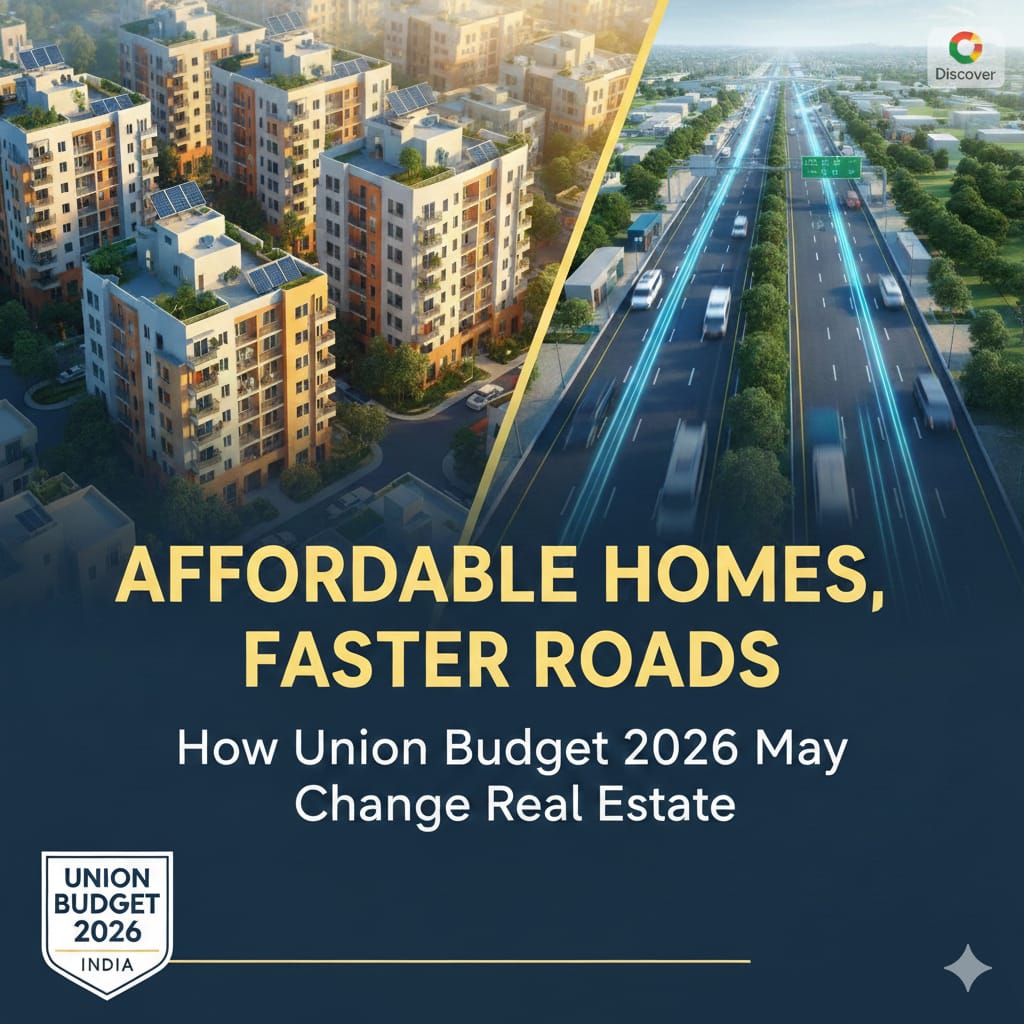
The Union Budget 2026 real estate effect is already a subject of keen interest among home buyers, builders, and investors. Even before any official statements, the budget trends have significance since the real estate sector is inextricably tied to government spending and budget trends.
In the past few years, the government has been using the budget to promote affordability, connectivity, and first-time home buyers. If this trend continues, Budget 2026 may have a significant, albeit under-the-radar, effect on the real estate sector in India.
This article will discuss what may happen, what is already in motion, and what home buyers can expect.
The Big Picture: Housing + Infrastructure = Growth
Real estate does not grow in a vacuum. It grows along with employment, roads, metros, and the beat of economic optimism. The government has focused on two distinct objectives in recent budgets. Affordable housing and increasing the supply of housing in urban areas Major infrastructure development
According to the Ministry of Finance, the government has been increasing its expenditure on infrastructure year by year since 2020, and this focus has been on roads, railways, and urban transport.
Source: https://www.indiabudget.gov.in
Budget 2026 is expected to continue this approach rather than introduce sudden policy shifts.
Affordable Housing: What Could Budget 2026 Do?
- “Housing for All” Remains a Focus
The need for affordable housing has continued to be a focus area under initiatives such as Pradhan Mantri Awas Yojana (PMAY). Although the timelines for PMAY might change, the overall thrust is still strong. - The future could hold:
- An extension or modification of incentives for affordable housing
- A continued thrust on the lower and middle housing segments
- A push for private builders to develop smaller, more affordable units
- As per the Ministry of Housing and Urban Affairs, demand for housing is strongest in the sub-Rs 50 lakh category in major cities
Source: https://mohua.gov.in - This indicates that the Budget 2026 housing schemes might have a stronger thrust on supporting demand rather than the luxury segment.
Tax Relief Expectations for Home Buyers: Will There Be Changes in Home Loan Tax Benefits?
Among the most talked-about features of any budget is its impact on home buyers. As of now, home buyers are eligible for the following:
- Home loan interest deduction under Section 24
- Principal repayment deduction under Section 80C
- Although there is no official proposal yet, CREDAI has been making the following demands:
- Increased limits for interest deduction
- Separate deduction for first-time home buyers
- These demands have been recorded in pre-budget memoranda submitted to the government
Source: https://credai.org - If any rationalisation or enhancement takes place in Budget 2026, it will have a direct impact on the affordability of housing, particularly in the metro areas.
Infrastructure Push: The Silent Real Estate Driver – Why Roads and Metro Lines Matter More Than Discounts
The prices of real estate properties do not increase due to mere announcements. They increase when the travel time decreases. The current infrastructure development in NCR is a classic example.
- Delhi-Mumbai Expressway
- Delhi Metro Phase IV Expansion
- Rapid Regional Transport System (RRTS) corridors
According to the National Highways Authority of India (NHAI), the development of expressways has resulted in a reduction of travel time between satellite cities by 30-40% in certain corridors
Source: https://nhai.gov.in
Budget 2026 is expected to provide more funds to complete these projects.
Delhi NCR Housing Market: What Could Change?
More Supply, Better Connectivity. The Delhi NCR residential market has turned more active again since 2023, largely due to infrastructure development and not speculative purchases.
The key trends emerging so far are:
Increased demand in Ghaziabad, Greater Noida, Sohna, and Dwarka Expressway
Homebuyers are showing a preference for better-connected locations in the outer areas
Mid-income segments are showing high demand in locations along metro and motorway routes. If the Budget 2026 continues to support transport infrastructure development in urban areas, these trends are likely to strengthen.
What is important to note here is that this increase appears to be led by end-users and not speculators, making it more stable
Impact on Property Prices: Should Buyers Worry? Will Prices Rise After Budget 2026?
In summary: prices could increase slowly over time.
History has shown us that budget announcements have not caused rapid price hikes overnight; however, Long-term appreciation is created through infrastructure announcements Increased absorption will occur as affordable housing is created, rather than causing sudden increases in price. Most tax incentives are designed to impact the purchasing decisions of buyers, not the base price for housing
Using RBI’s Residential Property Price Index, the rate of increase has been moderate throughout most major metropolitan cities after 2020, which indicates that Budget 2026 may provide for sustainable growth versus creating an unreasonable amount of overvaluation
Developers: What Does the Industry Want from Budget 2026?
Reducing Development Expenses and Speeding Up the Approval Process
Developers are not looking for free money; their main request is to change their structure:
- Rationalisation of GST on building materials
- Speeding up the one-stop approvals process
- Continuing access to institutional finance.
The Reserve Bank of India, as defined in its guidelines for Priority Sector Lending, has already included affordable housing as a priority sector. This will improve access to credit.
Source: http://www.rbi.org.in.
If they further improve liquidity and/or compliance definitions with Budget 2026, there may also be quicker project rollout times, which will indirectly benefit property buyers.
Rental Market Demand and Urban Migration – An Area That Has Been Missed
Infrastructure-driven economic development also impacts rental properties. The following factors all support:
- The migration of people relocating to areas outside the city centre
- Growth in the number of rental units located near major employment centres
- Increasing demand for small apartment-style living or functional homes.
In the NCR region of India, there have been many examples of the same trend along metro lines. If the budget provides additional support for urban transportation, this will strengthen rental returns in these micro-communities.
This is particularly compelling for young professionals and investors who want to receive stable rental returns instead of flipping properties in a short time frame.
What Home Buyers Should Do Now
Some practical things to take away are: buyers should be considering infrastructure completion rather than just budget expectations. Buyers should prefer locations where there is a confirmed infrastructure connectivity project. Buyers should consider evaluating their affordability based on whether they have stable income rather than relying on tax expectations.
Budgets provide guiding directions, but the timing, place, and longevity of the property will have a greater bearing on making a successful real estate investment. The additional benefit of a small tax deduction is helpful, but the most impactful benefit from making a real estate purchase is the longer commute time.
- Some risks to watch out for are:
- No budget comes without any issues or challenges.
- Examples of potential risks include:
- Infrastructure implementation delays.
- Increased construction costs due to global concerns.
- Limited fiscal space with which to provide large tax incentives.
- The Economic Survey indicates that the government continues to be disciplined in regard to its finances.
- Source: https://www.indiabudget.gov.in/economicsurvey.
- This means that expectations should be kept reasonable.
Final Verdict: Steady, Not Sensational
The likely impact of the Union budget for 2026 on real estate will be more evolutionary than it will be disruptive.
Through ongoing infrastructure spending, affordable housing initiatives, and gradual refinements to various policies, housing access and liveability in urban areas will improve over time.
This will be good news to buyers, but not necessarily to speculators hoping for much more dramatic announcements.
The primary element of real estate success is having a predictable policy environment with road construction and affordable housing, and if the 2026 budget delivers a portion of these two factors, the sector will quietly continue to build its future—brick by brick.
Summary-
The Union Budget 2026 must support the real estate sector by emphasizing affordable housing and large-scale infrastructure development. Improved roads, metro lines, and expressways may boost demand in well-located areas such as the Delhi NCR. Homebuyers will experience a gradual impact, making homes more affordable and liveable rather than triggering price increases. emphasising
Related Articles
Property Registration Rules 2026: Are Two Mandatory Documents Really Required
Delhi-NCR Property Market Warning Signs in 2026: Prices Up, Sales Down—What It Really Means

Harsh Katyan is a real estate content writer and researcher at Insta India Property. He specialises in covering Gurgaon and the Indian real estate market trends, property investment opportunities, and housing news.
He regularly publishes detailed property guides, market analyses, and investment insights to help buyers and investors make informed decisions.


Join The Discussion